
Team meetings that leave something behind
The team meeting ends and everyone heads back to their own files. Whoever was on minutes duty spent most of it half listening, and nobody quite remembers who was supposed to call the vendor back. Two weeks later, the same discussion starts over.
What KISMO does
On video calls, you invite KISMO into the meeting, on Google Meet, Zoom, Microsoft Teams or Webex. It joins the conversation, and the memory arrives at the end. Around a table, it's even simpler: you call your KISMO number, set the phone down in the middle and switch on the speaker. The meeting then runs as it always does.
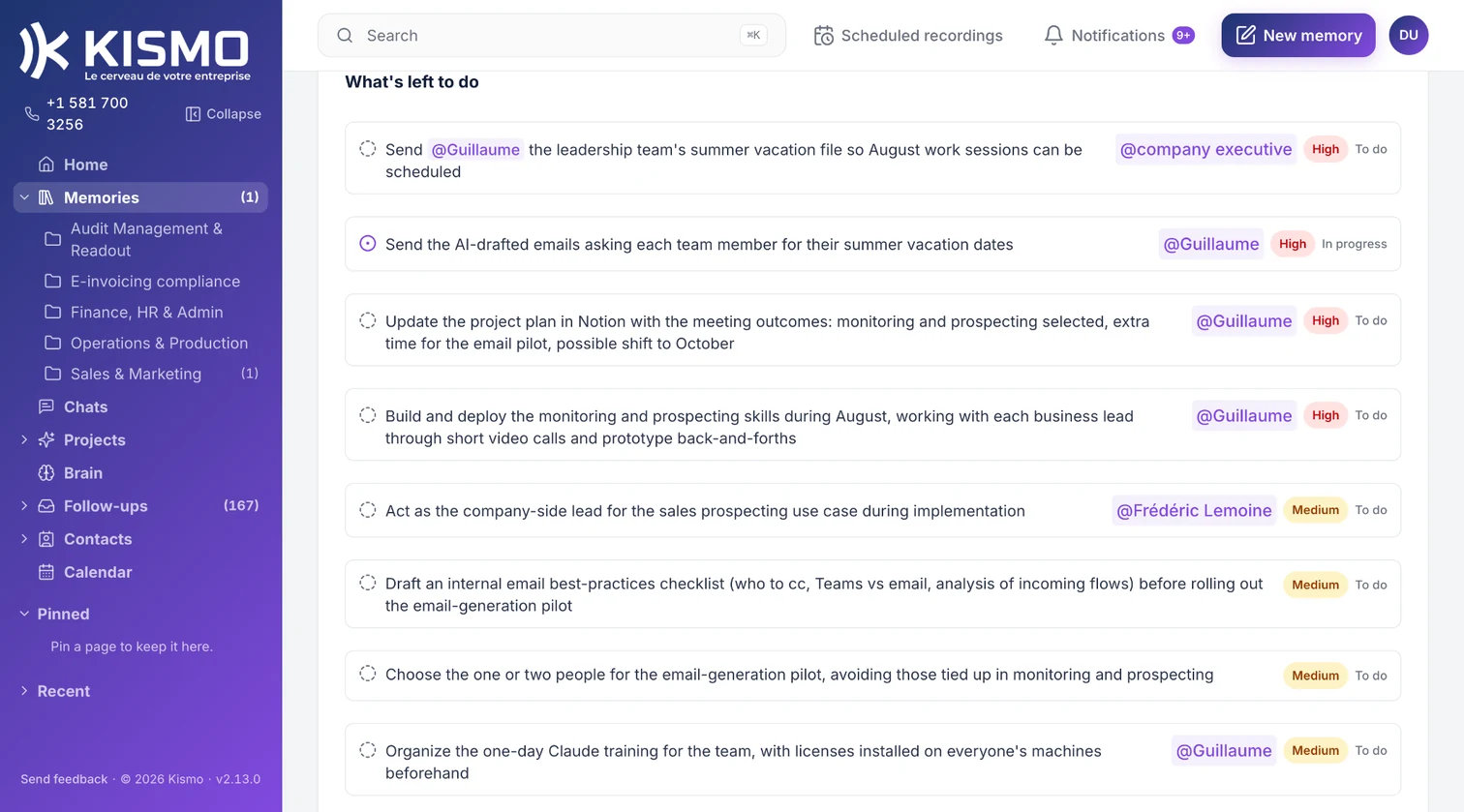
KISMO recognizes a meeting and gives it a full analysis: the topics discussed, the decisions made, the action items that follow. A mind map comes with the memory and shows the whole discussion at a glance, which helps when the agenda ran over.
What you gain
Nobody plays meeting secretary anymore: everyone takes part, and the memory becomes the reference. Decisions are in writing, and so are the actions. A colleague who missed the meeting reads the memory instead of asking for a hallway recap. And when a topic lands back on the table, you reopen last time's memory rather than replaying the debate.
Going further
The details of the video meeting invitation are on Invite KISMO to a meeting, and what a memory contains is on The memory. If your conversations happen mostly one on one, see the interviews use case.
What happens next?
Every memory of this kind can be distilled, that is, summarized: cut to what matters and kept current, to join your company's Brain. You review it, you click Distill, and later you ask it in one question.
Discover the Brain