
Your company never forgets again.
Less time searching, fewer mistakes, less rework, and knowledge that stays when people leave. KISMO gives your company a brain: its knowledge, centralized, distilled, and ready to answer, with sources.
Corporate amnesia: the information exists, nobody can find it
The unavailable
The information is in someone's head, and that head is in a meeting, on vacation, sick, or six time zones away.
The everyday
“What did we promise the client on Monday?” We search, we ask again, we redo.
The contradictions
Monday 2 meters, Thursday 3 meters, and nobody knows which one is the latest. Decisions get made on stale information.
Knowledge that walks out
Someone leaves, and a piece of memory leaves with them. Someone joins, and takes months to get up to speed.
25%
of leaders' and teams' time spent searching for answers
Atlassian, State of Teams 2025
56%
of employees have to interrupt someone to get information
Atlassian, 2025
42%
of company knowledge is not shared with any colleague
Panopto and YouGov, 2018
8.2 h
per week lost searching for, asking for again, or recreating information
APQC, 2021
Sources checked against the primary source on 09/15/2026: Atlassian (12,000 knowledge workers), Panopto (1,001 employees), APQC (982 knowledge workers).
The cost of forgetting: $557 for a one-hour meeting, and that's just the start
$557
A one-hour meeting with five people in the United States, at fully loaded employer cost. In France, about €424; in Quebec, about CA$400.
- Meeting time$375
- Poor quality (median scenario)$150
- Note-taking and minutes$32
KISMO internal study, 09/13/2026
$25,000
per year, roughly, for a single weekly team meeting
KISMO internal study, 09/13/2026
5.4 h
per week per person spent searching for knowledge the company already has
APQC, 2021 (two thirds of the 8.2 h)
$18,300
per year per person: the value of that internal search time
$75.20 per hour, 45 weeks
57%
of meetings are ad hoc calls, with no invitation and no minutes
Microsoft, The Infinite Workday, 2025
On kismo.ai, the cost of forgetting simulator lets visitors measure it with their own settings (country, participants, duration, frequency). KISMO promises no gain there: the visitor draws the conclusion.
KISMO: an organism, not a suite of tools
The senses
Calls, video meetings, speakerphone meetings, recordings, files, emails, web pages, texts. Your phone is all you need.
The memory
Memories (the note, in everyday words): what was said on a given day, intact, findable.
The Brain
Distilled, validated knowledge: what the company knows, has decided, must do, is still asking itself.
The conscience
You. Nothing gets in without a human: you review the memory and start the distillation.
The circuit, from speech to knowledge
- Capture
the senses
- Remember
the memory
- Validate
your call
- Distill
memory → knowledge
- Maintain
learn, forget
- Ask
sourced answer, 24/7
A hard drive fills up. A brain learns.
Nothing slips in unnoticed
You review the memory, you correct it, you click Distill. Each concept says which memory it came from.
In force · Concept · Decision
Website budget: $12,000
Replaces $8,000 (February) · replaced on April 3
Every answer cites its source and its status
In force, replaced, invalidated. Stale knowledge is never served as true.
Based on the memory from April 3
Mockup based on the demo corpus, never on real data.
You don't write anything. KISMO listens, you validate, it distills.
The Brain everywhere: readable by any AI, with consent
KISMO assistant, Claude, ChatGPT, Gemini, Code editors, Voice agent (beta)
An open standard: MCP
The universal connector for AI assistants. It is KISMO's public interface.
Consent spelled out
An external AI reads the Brain. With your permission, it can also mark an action done or a decision taken in it. It deletes nothing there. Permissions by family, adjustable box by box, revocable in one click.
It answers everywhere, 24/7
In KISMO, from the AI you already use, or by voice. It cites its sources and never serves an invalidated concept as true.
Today, people build an AI's context file by hand. The Brain is that file: produced by AI, validated by humans, served to any assistant.
The company that forgets, the company that learns
The company that forgets
The company that learns
Forty search results, none of them right
One answer, dated, sourced, in under a minute
Two sets of minutes that contradict each other
The latest decision, with the trail
The new hire takes six months, for lack of context
The new hire up to speed, with the history of decisions
Knowledge gone with the person who resigned
Knowledge kept, up to date
Everyone re-explains their context to their AI
The AI reasons on the validated Brain and cites the meetings
The mistake found at the client's, then “who said that?”
The contradiction caught before the quote, and “based on the meeting on the 12th”
What we measure in beta: validation minutes per meeting, questions asked and sourced answers, contradictions caught before they reach a client. No multiplier until it has been measured.
Your company is losing its memory.
What did we tell the client on Monday? What did we decide at the meeting before that? What gets said in meetings, on the phone, in emails and documents is forgotten, contradicted, redone, and it leaves with the people. Teams spend a quarter of their time looking for answers (Atlassian, 2025). Nobody rereads the minutes. The notebook you close is the notebook you forget.
What that costs is set out on The cost of forgetting.
Everything you hear, read and write, in one place.
You speak, you bring, you write. A call, a video meeting, a recording, an email, a message, a file, a web page, a note: everything lands in one place and becomes memory. Each source becomes a memory (a note, in everyday words). Your notes become memories, and your memories a brain. Your phone is enough. The full path is on How it works.
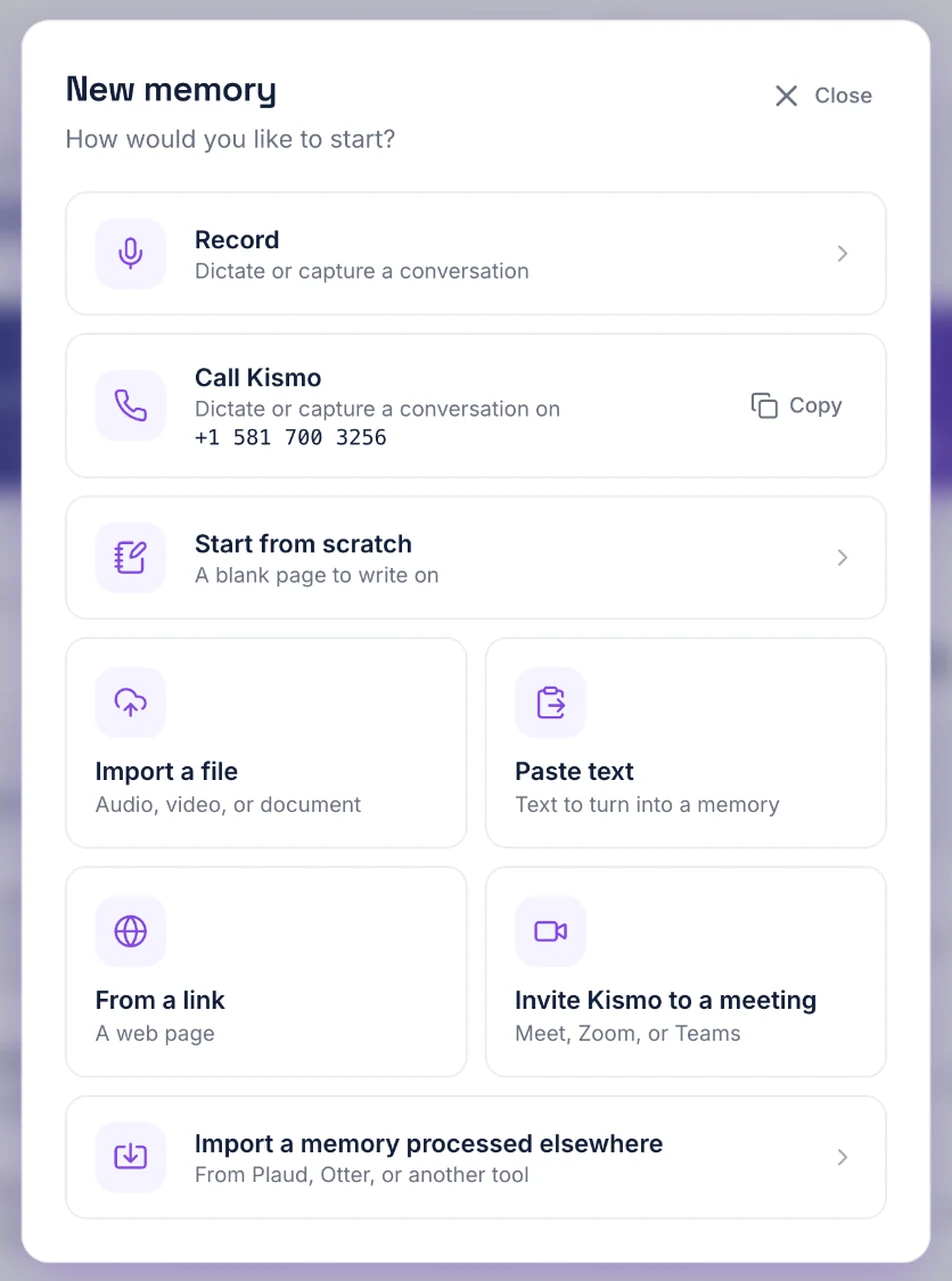
Distilled, with validation.
You validate each memory, then KISMO distills it, that is, it summarizes what matters and keeps it current: what you know, what you decided, what you have to do, what you are still wondering about. Nothing gets in unchecked. And when a decision changes, it knows which one is the latest.
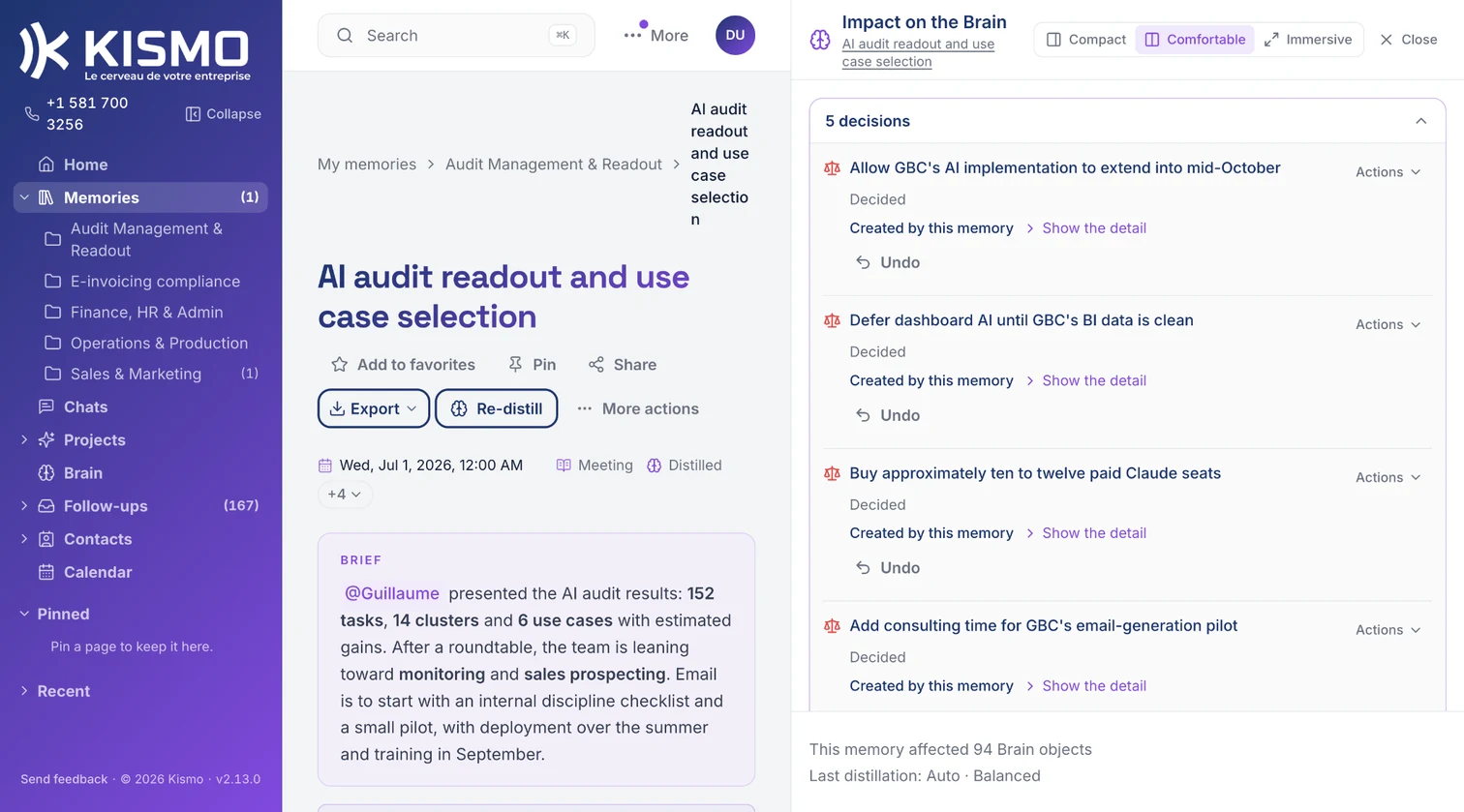
Ready to answer, with sources.
Ask a question inside KISMO, from the AI you already use, or out loud. The answer cites its sources and tells you what is true today. A hard drive fills up; a brain learns.
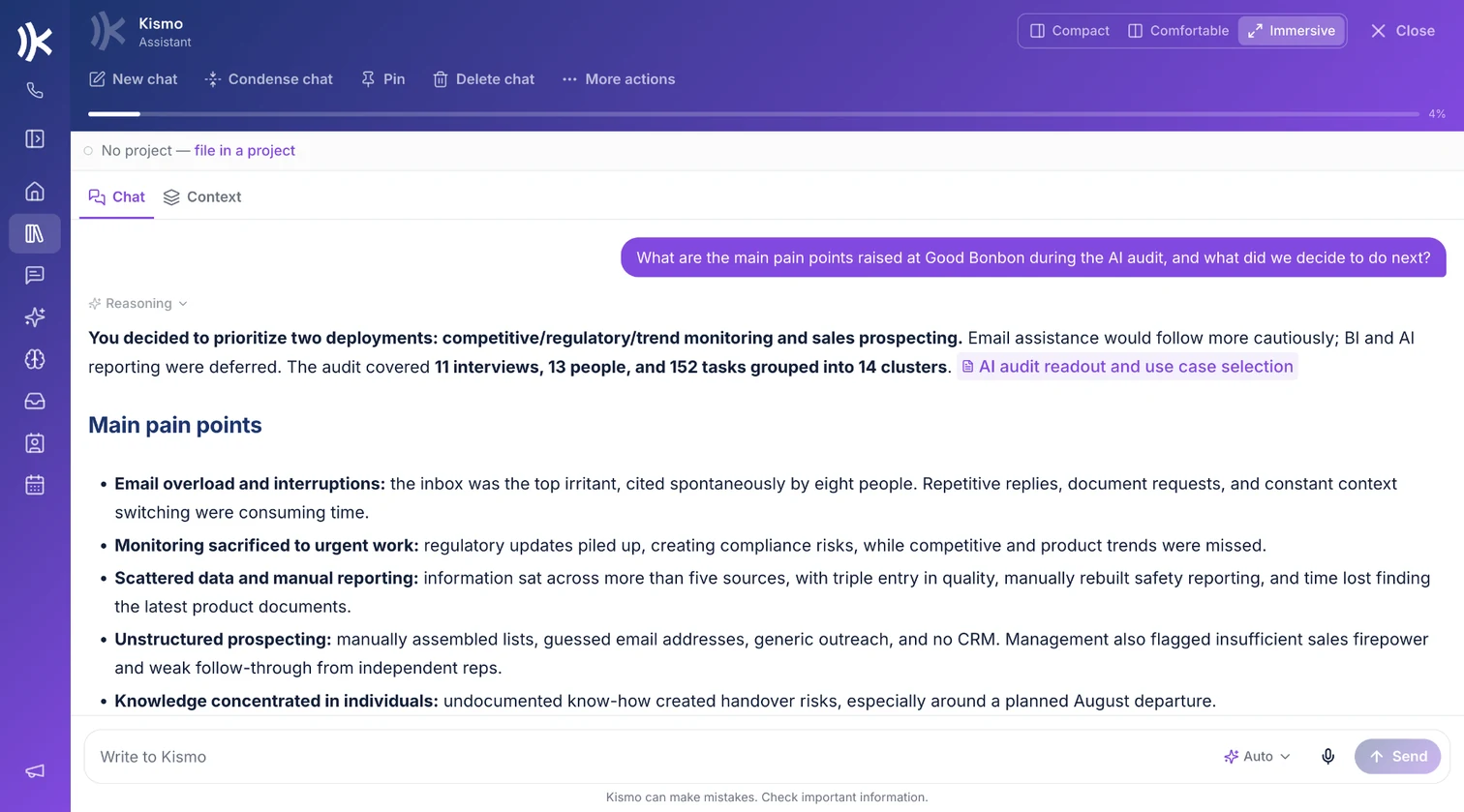
On Monday we said 2 metres, on Thursday 3.
It knows which one is the latest, and it shows you the meeting. Every piece of knowledge carries its sources and its state: in force, superseded, invalidated. That is the difference between searching a drive and asking a brain. Not a second brain. Your company's first brain. See The Brain and Company knowledge.
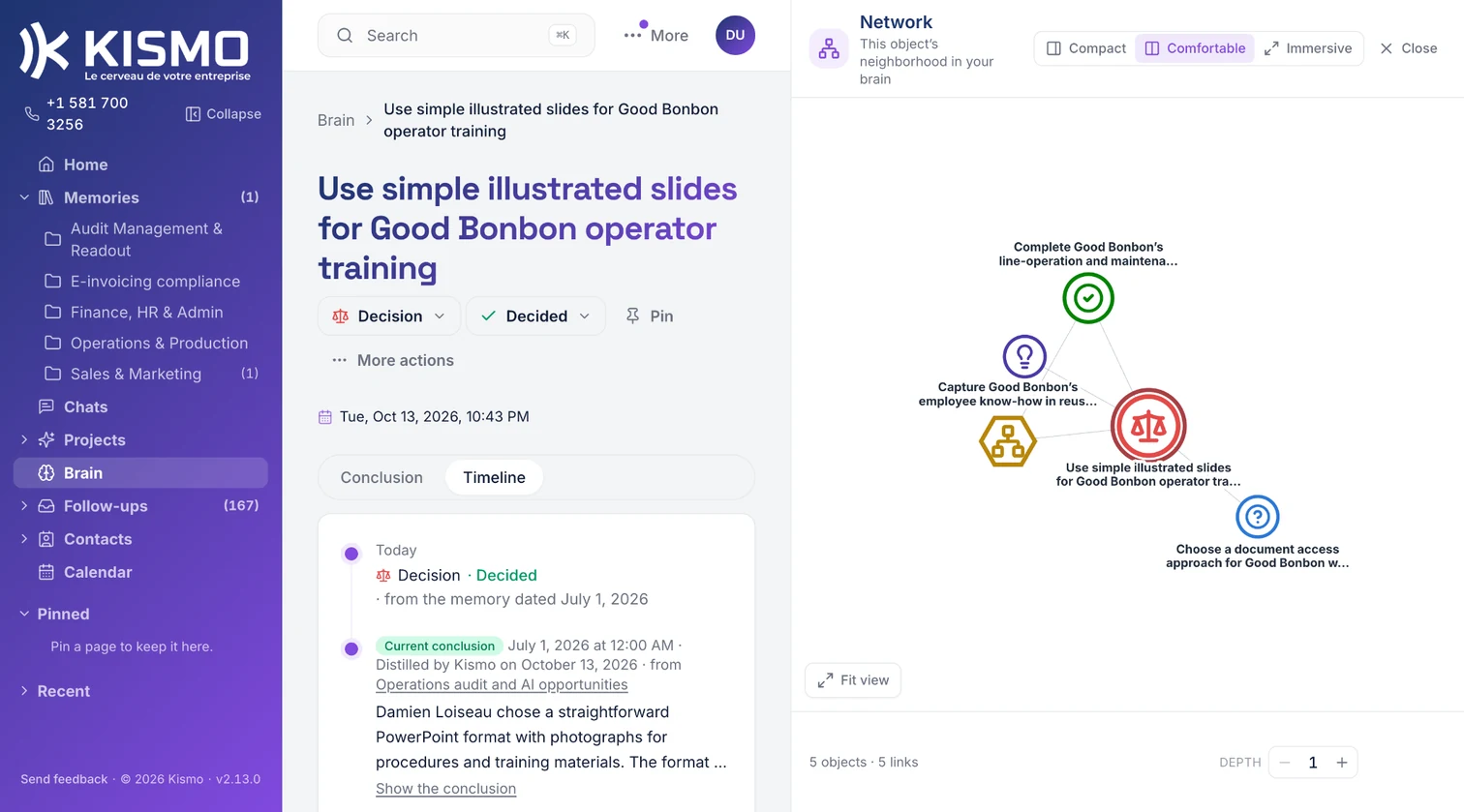
You write nothing down. KISMO listens, you validate, it distills.
The Brain is built from what you already do: your calls, your meetings, your emails, your documents. After each meeting, KISMO hands you the memory of what was said; you review it, you correct it, you click Distill, in a few minutes. That is all we ask of you, and it is what hand-built brains lack.
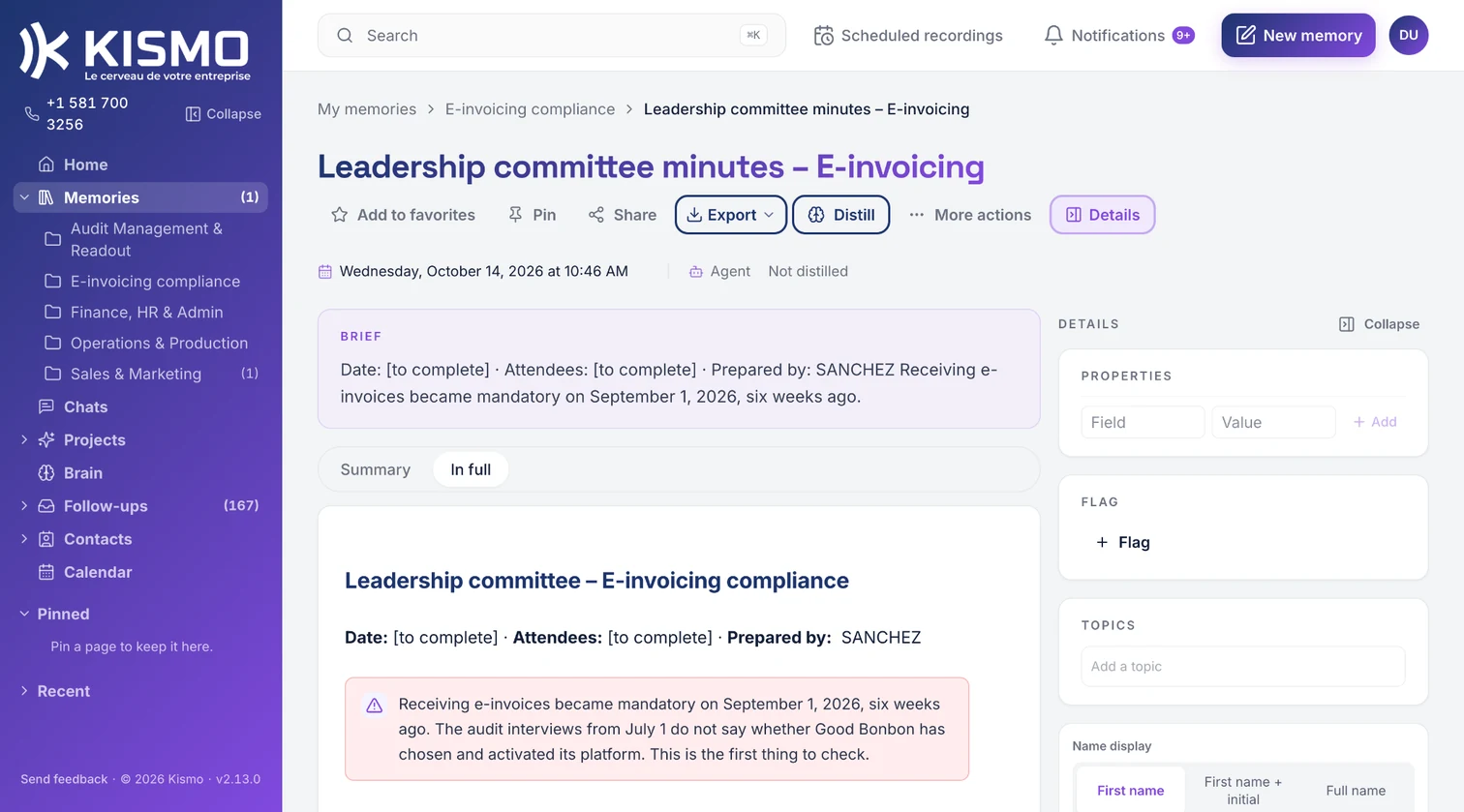
Your data, your knowledge.
Our servers are with OVH, in France. Your files are stored in the European Union. Partitioned by company, by space and by person. Two-factor authentication. Each memory can be exported at any time, and support sends you all your data on request. You can delete a memory and keep what the Brain drew from it. The detail is on Trust.
What forgetting costs you today.
A one-hour meeting with five people costs about 557 dollars in the United States, all in. Run the numbers with your own settings. KISMO boosts your company: every documented meeting pays back more than it costs.
Fifteen-day free trial.
Plans per person, per month, priced like a memory. Try it free for fifteen days, no credit card needed. See who KISMO is built for.