
Everything a recorder device does, without the device
Wearable recorders are multiplying: badges, pendants, pocket devices to set on the table. The promise is appealing, keeping a trace of your conversations. The method less so: one more object in your daily life.
What a recorder demands of you
You have to wear it, every day, for it to be of any use. Charge it, like everything else. The day the conversation matters, it sometimes stayed on the desk. And it has a hard limit: it captures what happens around it. A phone call escapes it.
The smartphone you already have is enough
KISMO adds no object. Your organization gets a dedicated KISMO number, and your phone does the rest. Four ways to capture a conversation:
- On a call: dial your KISMO number and talk. Dictation, a debrief straight after the fact, field notes.
- In an in-person meeting: same number, speakerphone on, the phone lying on the table.
- On a video call: invite KISMO to Google Meet, Zoom, Microsoft Teams or Webex. The memory arrives at the end.
- From a file: audio or video up to 2 GB, PDF, Word, text or Markdown documents up to 50 MB.
No app to install, no hardware to charge.
A device records, KISMO delivers a memory
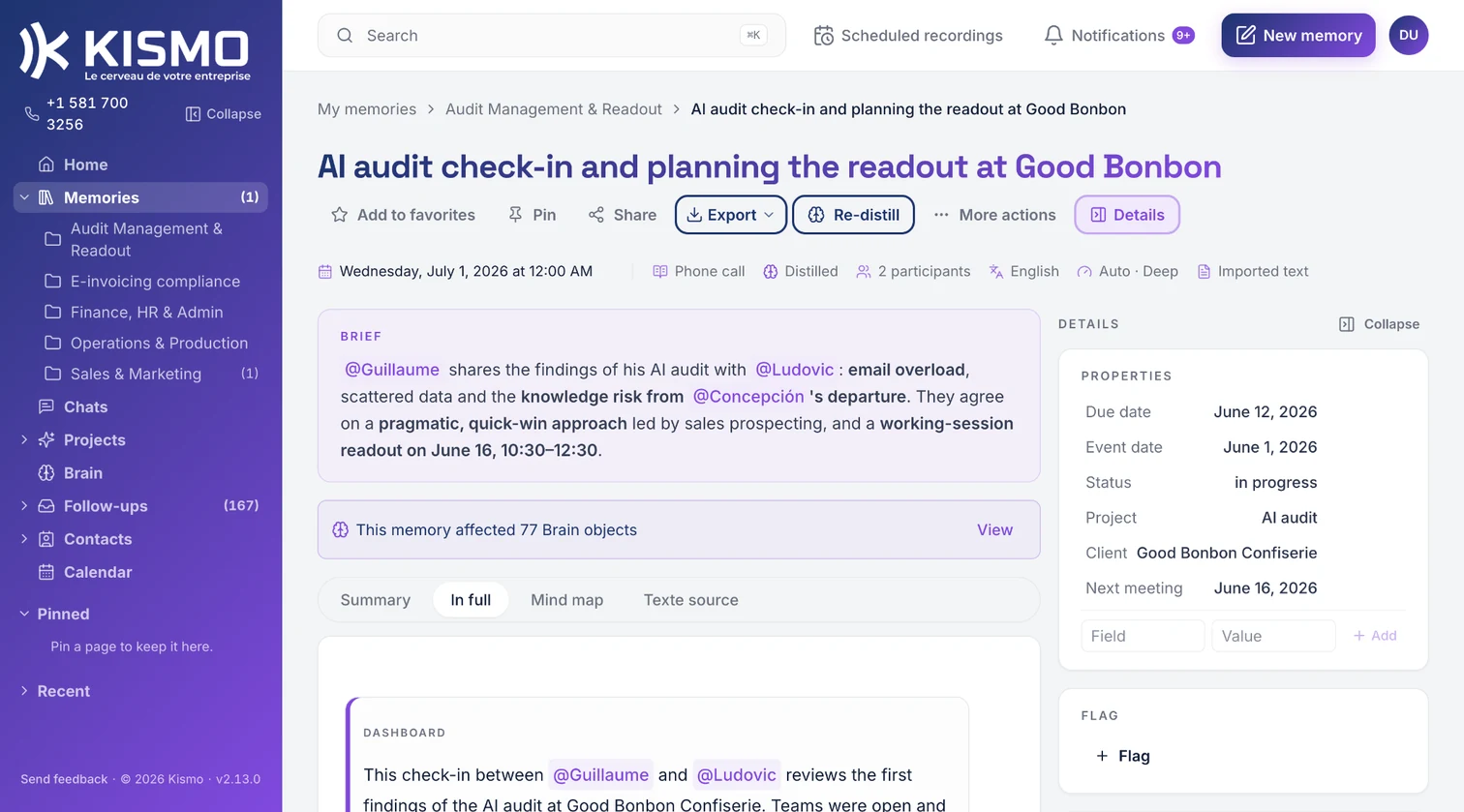
Recording is only the first step. KISMO transcribes, identifies who is speaking and returns a structured memory: title, summary, decisions, action items, mind map, full transcript. You receive it by email, and it waits for you in your account.
That space is kept in order: folders, favorites, a search that works by meaning as much as by exact words. An assistant answers from your memories and cites its sources. Each memory can be distilled into the Brain, a memory that grows conversation after conversation.
Frequently asked questions
Do I need to install anything?
No. A dedicated phone number and a web workspace. No app, no hardware.
How does KISMO capture an in-person meeting?
You call your KISMO number and turn on the speakerphone. The memory then arrives by email.
What the device does well: it captures. Sitting on the table, it records what is said around it.
Where it stops: the room it sits in, the battery, and a platform that produces transcripts without knowing what contradicts what.
If you already own a Plaud device, its recordings import in one go, with their transcripts, with no duplicates, and it becomes one source among others.
The memory is the raw material. The Brain is what is left of it.
A memory keeps what was said, that day, intact. The Brain keeps what your company retained from it: what it knows, what it decided, what it has to do, what it is still wondering about. You review, you distill, nothing gets in without you.
Discover the Brain